
How do we know?
I have been ruminating on how media, politics, and the internet intersect to romanticize and rewrite history. It’s not really a new phenomenon. What has changed is the speed, scale, and persuasive power with which it happens. There is a particular kind of historical fact that we believe we know because we have seen it. Seen it so many times, it is indelibly printed on the psyche.
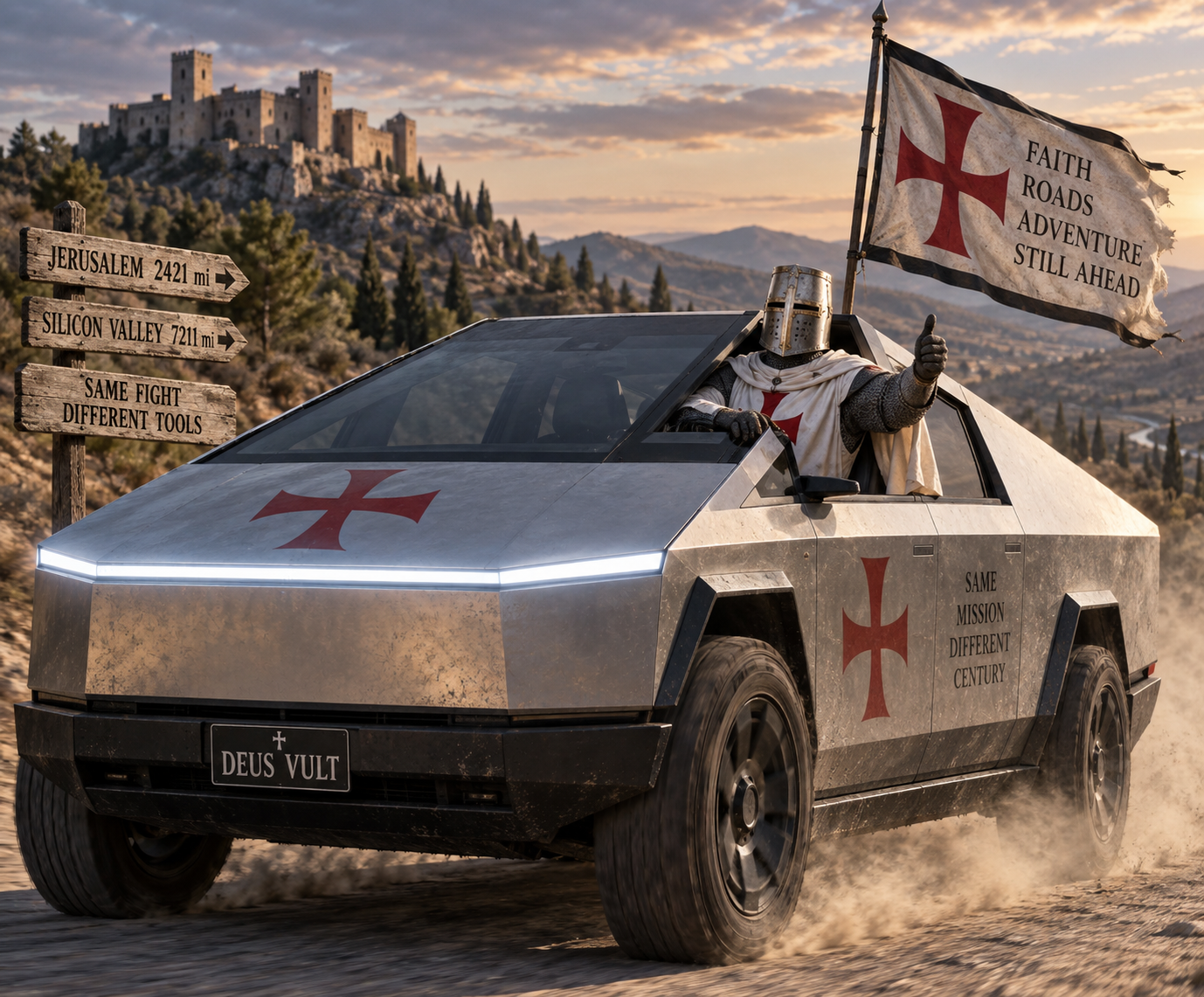
Take this, for instance: Knights Templar wore white cloaks with big red crosses.
Of course they did. I have seen them. You have too.
They’ve marched through movies, television series, paintings, video games, book covers and documentaries for most of our lives: white mantle, red cross, sword, mail, perhaps a rather magnificent beard.
So I asked what seemed like an extraordinarily simple question. What is the evidence of this garb? Surely somewhere there is a Templar mantle in a museum. A battered piece of white wool, perhaps, with the remnants of a red cloth cross sewn onto it. Or a contemporary painting showing precisely what we’ve been reproducing ever since.
As far as I can discover, there isn’t.
At least, not one that historians can confidently identify as an original Templar mantle from the period. The evidence is stranger, and considerably more interesting.
The medieval Rule of the Templars specifies white mantles for the knight-brothers. Contemporary chroniclers tell us that red cloth crosses were subsequently attached to those mantles. There are surviving paintings made while the Templars still existed. There are even surviving Templar frescoes: at San Bevignate in Perugia, painted around 1260–1270 while the Order still existed, we find Templar knights, brothers in white religious dress, crosses and the Order’s black-and-white battle standard bearing its red cross. What is surprisingly difficult to find is an early, unambiguous surviving image showing exactly the white-mantle/red-cross combination that we recognize instantly.
The pieces are there. It doesn’t mean the familiar image is false. Quite the opposite: there is good historical evidence behind most of it. But over centuries, reconstruction became illustration, illustration became convention, convention became cinema, and cinema became memory.
Eventually, we stopped seeing an interpretation. We created a fact.
Cleopatra becomes Elizabeth Taylor reclining in Egyptian luxury. Vikings acquire horned helmets. Medieval Europeans become people who routinely believed the Earth was flat. Napoleon becomes unusually short. Marie Antoinette tells starving peasants to eat cake. The Wild West fills with men settling disputes by meeting at high noon in the middle of Main Street on the daily.
Some of these things are false. Some contain fragments of truth. Others are broadly accurate but have accumulated details for which the evidence is much weaker than our confidence in them.
There are things we know from surviving objects. Things we know because several independent contemporary sources describe them. Things reported decades later. Things inferred from archaeology. Things reconstructed from similar examples. Things that are plausible. Things historians argue about.
And then there are things someone like director Ridley Scott made look really convincing.
Modern visual culture collapses all of those categories into one. Once someone builds the costume, dresses an actor in it, lights him beautifully and sends him galloping across a desert, uncertainty disappears. The image becomes extraordinarily difficult to unsee.
This isn’t an argument against historical movies, paintings, museums or reconstructions. They are some of our most powerful ways of trying to experience the past.
It is an argument for noticing the seam between evidence and reconstruction. That seam is everywhere. In the current political and cultural climate, learning to see that seam may be one of the essential skills of citizenship.
More concerning to me, however, is AI imagery.
Artificial intelligence can generate a photograph of a Templar knight in seconds. It can generate a Roman street, a Viking feast, Cleopatra’s palace or Jesus walking through first-century Jerusalem with a degree of photographic persuasion no Victorian illustrator could have dreamed of. The danger isn’t necessarily that these images are wildly wrong. It is that they look equally convincing when they are right, wrong, disputed or simply unknown.
We are entering an age in which visual certainty is becoming cheaper precisely as epistemic certainty becomes more valuable.
AI didn’t invent our tendency to mistake representation for evidence. It industrializes it.
I’ve argued in the past for triangulating news. We need to learn to triangulate images as well—but three images that agree aren’t enough. We need independent provenance. Who made the image? When? Where did it first appear? Can its origin be traced to a credible source? Is there another independently sourced image of the same event? Three copies of the same visual aren’t triangulation.
Which brings me back to that white mantle.
Did Knights Templar wear white mantles with red crosses? Yes. There is good evidence that they did in certain periods.
Did they look exactly like the Templars we recognize instantly on a movie screen? That’s a different question.
Whenever history looks particularly familiar, ask where you first saw it.
Then ask a more dangerous question: How do we know?