Freedom's just another word ...
… for nothing left to lose.
Thank you, Janis, for the reminder on this first day of early voting in NM.
There is a word I keep expecting to hear more often from the American left.
Freedom.
Not because Democrats never use it. They do. Reproductive freedom. Freedom to vote. Freedom to marry. Freedom of speech. Freedom of religion. But mostly as a modifier. A collection of freedoms.
I keep wondering why freedom itself isn’t the organizing principle.
Look around outside of our shores. This week Germany’s president warned that his country risks something resembling the political fragmentation of the Weimar era, fueled by disinformation and anti-democratic extremism. War continues grinding through Ukraine, including attacks on civilian infrastructure as winter approaches. Fighting has intensified again in Yemen, around one of the world’s critical shipping corridors. Commercial ships have been struck by drones in the Black Sea. Oil and fuel supplies are tightening as conflict spreads through the Middle East.
Underneath much of it is a very old human question: Who gets to control whom?
And here at home in America, we are exhausted.
An AP-NORC poll released October 1 found only 17 percent approving of the president’s handling of the cost of living. Sixty-five percent said current unusually high prices were a result of Trump administration policies. Another AP-NORC survey found something perhaps even more revealing: only about two in ten registered voters thought either major political party was particularly concerned with helping people like them.
That is not merely partisan dissatisfaction. It’s total alienation.
And this is where I think Democrats—and the broader democratic left—are missing an extraordinarily simple piece of language:
Freedom.
Not freedom as the flag-waving possession of one political tribe. Not reduced to the right to buy something, carry something, refuse something or be taxed slightly less.
The older, larger concept. The principle this country actually claimed to be about.
Two hundred and fifty years ago, some deeply imperfect men wrote something astonishing:
“That to secure these rights, Governments are instituted among Men, deriving their just powers from the consent of the governed.”
Read that carefully. Government was not described simply as the enemy of liberty. Government existed to secure liberty.
Life. Liberty. The pursuit of happiness.
And when government instead became destructive of those things—when power became arbitrary, unaccountable and detached from the consent of the people—the Declaration argued that government had violated the purpose for which it existed. We have spent decades allowing the word freedom to become much smaller than that.
Freedom ought to mean that government cannot tell you whom you may love.
Freedom ought to mean that your neighbor’s religious beliefs do not determine your medical care.
Freedom ought to mean that the state cannot punish a newspaper because its coverage displeases politicians.
Freedom ought to mean that you can cast a ballot without intimidation and expect it to be counted.
Freedom ought to mean that a politician cannot simply place himself above laws that constrain everyone else.
Freedom ought to mean that your child can pick up a book without somebody else’s religious doctrine deciding whether it may exist.
Freedom ought to mean that a gay kid in Oklahoma and a trans kid in Texas and a Christian kid in Massachusetts and an atheist kid in Alabama all possess the same right to become themselves.
But freedom isn’t only protection from government. That’s the part we seem to have forgotten.
A person drowning in medical debt isn’t especially free.
A woman who cannot leave an abusive husband because his job provides the family’s health insurance is not entirely free.
Someone working two jobs while wondering whether this month’s rent increase finally puts him on the street possesses plenty of theoretical liberty. It may not feel much like freedom.
A parent choosing between insulin and groceries does not become freer because government refrains from interfering with the choice.
This is not just MAGA, Republicanism. This is also the fault of neoliberal Democratic principles set in place during the Clinton presidency in the 90’s. We turned away from the New Deal Democratic philosophy to align closer to business interests.
Franklin Roosevelt understood the danger, pulling America out of the Depression.
In 1941, with authoritarianism consuming much of the world, Roosevelt described four essential human freedoms: freedom of speech, freedom of worship, freedom from want, and freedom from fear.
Those last two matter.
Freedom from want. Freedom from fear.
They acknowledge something that much of American political language has since forgotten: liberty can be taken from us by more than government regulation.
Poverty can take it. Disease can take it. A monopoly can take it. An employer can take it. A violent spouse can take it. A mob can take it. A billionaire with vastly more political influence than the people who work for him can take some of it. (And can fiddle with elections internationally, too, I might add.) And yes, an authoritarian government can take it very quickly indeed.
The common denominator is not left versus right.
It is power.
Who has it? Who doesn’t? Who can exercise it over somebody else without meaningful restraint?
This is why I find the left’s political vocabulary so frustrating sometimes. We have dozens of individual policy arguments—healthcare, wages, reproductive rights, LGBTQ rights, voting rights, unions, education, housing, corporate concentration—and then spend enormous amounts of energy explaining each one independently.
They are not independent. They are variations on the same proposition:
A human being should have enough autonomy, security and political power to direct his or her own life.
There is a word for that.
Freedom.
Healthcare? Freedom from having illness destroy everything you spent your life building.
A living wage? Freedom from desperation.
Social Security? Freedom from destitution after a lifetime of work.
Unions? Freedom for workers to negotiate with concentrated economic power rather than face it individually.
Reproductive rights? Freedom over your own body.
LGBTQ rights? Freedom to live and love without somebody else’s morality being written into law.
Voting rights? Freedom to participate in the government that exercises power over you.
A free press? Freedom to know what that government is doing.
Due process? Freedom from arbitrary state power.
Separation of church and state? Freedom of religion—which necessarily includes freedom from somebody else’s religion.
None of this requires inventing some brave new political philosophy. We already wrote it down.
Life. Liberty. The pursuit of happiness. Consent of the governed.
And the remarkable passage immediately following those famous words warns about a “long train of abuses and usurpations” that gradually reduces a people under absolute power. The authors were talking about George III, of course. But the principle survives perfectly well. Free societies do not depend upon benevolent rulers.
They depend upon limits on rulers.
They depend upon courts, legislatures, elections, journalists, laws, civil servants, citizens and institutions capable of saying no.
That isn’t obstruction. That’s the machinery.
A recent Gallup/Kettering survey found 56 percent of Americans saying the rule of law in the United States has weakened, while 78 percent agreed that government officials should always follow the law and Constitution. Two-thirds still considered democracy the best form of government.
That doesn’t sound to me like a country clamoring for a more complicated ideological vocabulary.
It sounds like one searching for something much more basic.
A life I can afford. A government I can trust. A vote that matters. A body that belongs to me. A family nobody can outlaw. A newspaper the president cannot silence. A religion I may practice—or decline to practice. A job that doesn’t own me. A doctor I can afford to see. A retirement that doesn’t end in terror. A country in which political defeat means you lost an election, not that somebody gets to become your ruler.
Freedom.
It is an extraordinarily American word. Past time to reclaim its full meaning. Democrats, are you listening? Hear it now. We prisoners wish to say a word.
Amazing Grace.
’Twas a beautiful, post-rain hike. Sure, a little squishy, but not enough to soak low outdoor sneaks to sodden pulp. The grades were steep, the aspens yellow and glowing magically, the vistas expansive and technicolor. All in all, except for the effort at altitude, a perfect afternoon.
Just past the halfway mark on this intended jaunt, I came upon a pair looking completely shell-shocked. I asked what was wrong. The older couple, both in their 70s, related a tale of grave woe. They had both just retired and had come for a two-night celebration of the fact. The high point of their little adventure was to be a leisurely three hour hike. Instead, they had encountered a cow moose, her calf and a very large bull, agitated and occupying the only stream crossing on that section of the route.
Apparently the two had come upon the moose family, and the husband went close—“20 feet, that’s all”—to take smartphone photos of the enormous male. I was shown the photos. He was a magnificent specimen, his shoulder appearing nearly as tall as my head. The bull did not appreciate the attentions of husband-with-smartphone. He began making lunges.
The wife started yelling, soon joined in duet by her husband, while they backed away and tried to put the larger aspen trunks between themselves and the moose. The bull charged four times. At one point the wife began pelting him with rocks. He stopped perhaps two feet from her, antlers down and apparently quite prepared to do some damage.
The wife, a singer, decided the logical solution was to belt out “Amazing Grace” at the top of her lungs.
This did not convince the bull moose to reconsider his position.
Hence my meeting with the shocked, crestfallen couple retreating swiftly up the rocky trail.
I then began noticing things. Neither had warm clothing. Each carried a partially filled bottle of water. Sneakers. No food or snacks. No hiking poles. Nothing much at all for spending an unexpectedly long afternoon in the mountains. We had about three hours of daylight left. Backtracking would take at least two and a half.
There was nothing for it but to “adopt” these two and shepherd them back to the parking lot, helping them through the more difficult passages. The hardest part was convincing them of the urgency of walking briskly. Once the sun disappeared behind the mountains, the temperature would fall quickly, and they weren’t equipped for darkness or cold.
We still had substantial climbing ahead of us, and they were going to need what remained of their stamina. A turned ankle or bad fall could change the equation considerably. Bursting into song was not going to assist in this case.
Suffice it to say, we made it back with the sun just disappearing behind a ridge. As predicted, the forest went dark, the temperature dropped, and everyone returned to their cars safe and sound.
I took several lessons from the afternoon: Twenty feet is too close to an agitated bull moose. Throwing rocks at his face is unlikely to improve his disposition.
And, based upon the admittedly limited sample size available to me, I can report that liturgical wildlife management is a fail.
On AI and reason.
Aeon: Intelligence is more than optimisation. This one is really, really good. Don’t miss it. And don’t read it in a work context - be at ease, cup of tea or coffee, to consider the ramifications.
Autumn, after an unusually hot summer ...
More brown than yellow, encouraging new perspectives. A patchy autumn, not the grandeur of previous years.

Beware when the media gets confident of election turnout.
I see the NY Times, and other sources shifting to a sense of blue inevitability. I remember 2016 too well. Beware.
Election coverage can make a race feel settled before voters have finished deciding it. Looking back at the New York Times’ 2016 coverage, then-executive editor Dean Baquet said he would have edited early stories to give less of a sense Hillary Clinton’s ‘win’ as inevitable. He also acknowledged relying too heavily on party insiders and spending too little time reporting across the country. Jay Rosen’s account of Baquet’s interview records those admissions. They basically had noone on the ground in the Midwest; just opined from their tall skyscrapers in Manhattan.
The election result cannot be reduced to a story about supporters staying home. Census Bureau figures show that overall turnout was statistically similar to 2012. Within that total, Black turnout fell from 66.6% to 59.6%, while white turnout rose. Those shifts mattered, but turnout was only part of what changed. Voters changed their choices, too. A study of six states found that switching between parties explained more of the change in results than turnout did in four of them, including Michigan and Pennsylvania.
Beware hubris. On the part of the parties, on the part of the media.
The lesson for anyone reading an election forecast is to leave room for what it cannot see. Confidence about a result is a description of the evidence available at the time. It is not a substitute for reporting on voters, and it is not a result.
A Machine With No Last Version.
John von Neumann worked out the logic of a machine that could carry its own instructions and build a copy. Add one more instruction: Make copies of yourself, and work toward constant, neverending improvement. Every generation after that improves the next.
The systems in The New York Times story are software, and they still need human researchers to supply much of the judgment and imagination. But imagine joining recursive self-improvement to von Neumann’s physical machine. Each copy becomes another worker on the next design. A better design makes more capable workers.
Better at what? How is “improvement” chosen? And what is it allowed to consume along the way?
“Neverending improvement” has no finish line and no built-in reason to leave us in charge. These AI constructs actively work against boundaries. If a future machine learns to regard our limits as flaws in its design, it will be taking the assignment seriously …
How do we know?
I have been ruminating on how media, politics, and the internet intersect to romanticize and rewrite history. It’s not really a new phenomenon. What has changed is the speed, scale, and persuasive power with which it happens. There is a particular kind of historical fact that we believe we know because we have seen it. Seen it so many times, it is indelibly printed on the psyche.
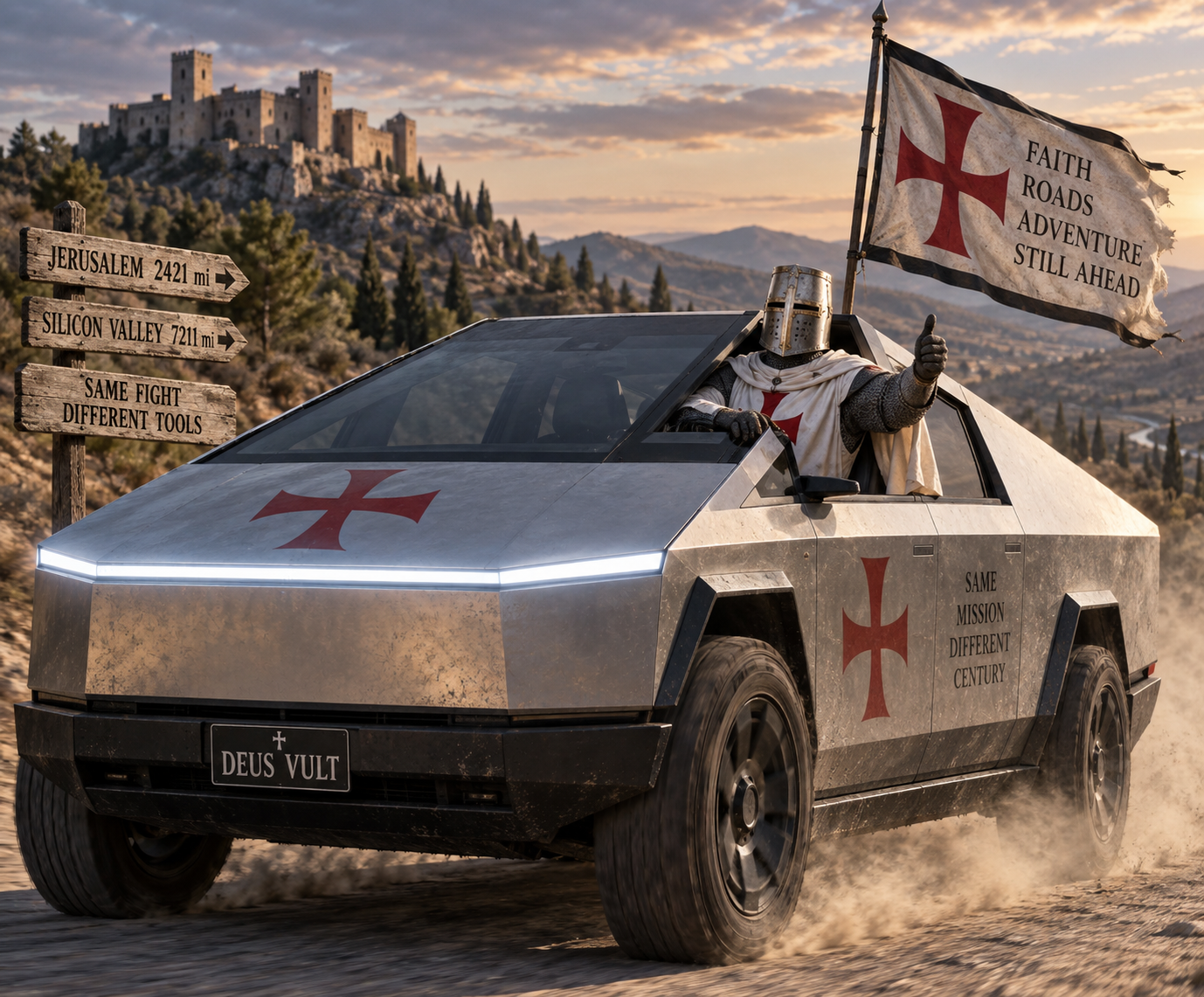
Take this, for instance: Knights Templar wore white cloaks with big red crosses.
Of course they did. I have seen them. You have too.
They’ve marched through movies, television series, paintings, video games, book covers and documentaries for most of our lives: white mantle, red cross, sword, mail, perhaps a rather magnificent beard.
So I asked what seemed like an extraordinarily simple question. What is the evidence of this garb? Surely somewhere there is a Templar mantle in a museum. A battered piece of white wool, perhaps, with the remnants of a red cloth cross sewn onto it. Or a contemporary painting showing precisely what we’ve been reproducing ever since.
As far as I can discover, there isn’t.
At least, not one that historians can confidently identify as an original Templar mantle from the period. The evidence is stranger, and considerably more interesting.
The medieval Rule of the Templars specifies white mantles for the knight-brothers. Contemporary chroniclers tell us that red cloth crosses were subsequently attached to those mantles. There are surviving paintings made while the Templars still existed. There are even surviving Templar frescoes: at San Bevignate in Perugia, painted around 1260–1270 while the Order still existed, we find Templar knights, brothers in white religious dress, crosses and the Order’s black-and-white battle standard bearing its red cross. What is surprisingly difficult to find is an early, unambiguous surviving image showing exactly the white-mantle/red-cross combination that we recognize instantly.
The pieces are there. It doesn’t mean the familiar image is false. Quite the opposite: there is good historical evidence behind most of it. But over centuries, reconstruction became illustration, illustration became convention, convention became cinema, and cinema became memory.
Eventually, we stopped seeing an interpretation. We created a fact.
Cleopatra becomes Elizabeth Taylor reclining in Egyptian luxury. Vikings acquire horned helmets. Medieval Europeans become people who routinely believed the Earth was flat. Napoleon becomes unusually short. Marie Antoinette tells starving peasants to eat cake. The Wild West fills with men settling disputes by meeting at high noon in the middle of Main Street on the daily.
Some of these things are false. Some contain fragments of truth. Others are broadly accurate but have accumulated details for which the evidence is much weaker than our confidence in them.
There are things we know from surviving objects. Things we know because several independent contemporary sources describe them. Things reported decades later. Things inferred from archaeology. Things reconstructed from similar examples. Things that are plausible. Things historians argue about.
And then there are things someone like director Ridley Scott made look really convincing.
Modern visual culture collapses all of those categories into one. Once someone builds the costume, dresses an actor in it, lights him beautifully and sends him galloping across a desert, uncertainty disappears. The image becomes extraordinarily difficult to unsee.
This isn’t an argument against historical movies, paintings, museums or reconstructions. They are some of our most powerful ways of trying to experience the past.
It is an argument for noticing the seam between evidence and reconstruction. That seam is everywhere. In the current political and cultural climate, learning to see that seam may be one of the essential skills of citizenship.
More concerning to me, however, is AI imagery.
Artificial intelligence can generate a photograph of a Templar knight in seconds. It can generate a Roman street, a Viking feast, Cleopatra’s palace or Jesus walking through first-century Jerusalem with a degree of photographic persuasion no Victorian illustrator could have dreamed of. The danger isn’t necessarily that these images are wildly wrong. It is that they look equally convincing when they are right, wrong, disputed or simply unknown.
We are entering an age in which visual certainty is becoming cheaper precisely as epistemic certainty becomes more valuable.
AI didn’t invent our tendency to mistake representation for evidence. It industrializes it.
I’ve argued in the past for triangulating news. We need to learn to triangulate images as well—but three images that agree aren’t enough. We need independent provenance. Who made the image? When? Where did it first appear? Can its origin be traced to a credible source? Is there another independently sourced image of the same event? Three copies of the same visual aren’t triangulation.
Which brings me back to that white mantle.
Did Knights Templar wear white mantles with red crosses? Yes. There is good evidence that they did in certain periods.
Did they look exactly like the Templars we recognize instantly on a movie screen? That’s a different question.
Whenever history looks particularly familiar, ask where you first saw it.
Then ask a more dangerous question: How do we know?
Texas Is What Later Looks Like.
I’ve been talking about the wells buried beneath Texas since at least the early 2000’s—and all through the attempt to bring oil and gas drilling into the Galisteo Basin. This is why.
Texas has records of some 1.2 million wells, including roughly 300,000 supposedly plugged wells. A new Texas Observer investigation identifies more than 25,000 plugged wells at critical risk of failure. Cement cracks. Toxic brine and gas find their way upward. Companies disappear. Texas, back when, had two inspectors for their entire state, as I recall - just as the fracking boom was starting.
During the Galisteo fight here in Santa Fe, the industry wanted to talk about what might come out of the ground. Selling fracking (without using the word) as ‘modern’ and ‘clean.’ I kept talking about what would be left behind—and who would inherit it after the profits were gone.
Texas is what “later” looks like. And it ain’t pretty.
Via silentLurker on Mastodon.
Trust Is a Reserve Asset.
For a century, nations stored gold in New York because the United States was where you put valuables when the rest of the world became dangerous. Now European central banks are planning for the possibility that America itself may be part of the risk.
The Netherlands shifted 86 tonnes from New York and Ottawa to London, officially to make the gold more tradable and accessible during a crisis. France sold its remaining 129 tonnes in New York and bought replacement gold in Europe—a move the Banque de France says was “technical”, not political.
None of this means Washington is going to seize Europe’s bullion. DW reports posits that such a seizure remains extremely unlikely. But central bankers do not reposition reserves because disaster is certain. They do it because trust is no longer unconditional. I don’t blame them one bit.
Gold beneath Manhattan, in Fort Knox, was a physical expression of the American-led order: safe custody, stable rules and predictable alliances. Reliability. These changes in policy tell us everything about trust of the United States.
I pause to remember 9/11.
The videos are playing again, the horrors renewed. I wasn’t there that day, but I often passed through the World Trade Center during my years working in New York. The PATH station underneath. Those massive escalators—you couldn’t see the top from where you stepped on—emptying you onto the streets. I saw my first portable Osborne computer there, sitting beside a man waiting for a limo at the foot of the South Tower. For a year and a half, the towers were part of my daily commute to 1 New York Plaza.
This blog served as a sort of hand-built feed for that first generation of bloggers before RSS was widely used. During this crisis the site received thousands of visits a day.
These are contemporaneous records of what was being reported, feared and understood as events unfolded. Some early reports later proved wrong. I have not altered them retrospectively.
Read each day from bottom to top:
9/11, 9/12, 9/13, 9/14, 9/15, 9/16, 9/17, 9/18.*, **
A note before reading: If you lived through the attacks in New York, these posts may bring those days back with force. Please read only if you feel ready.
Coincidences, in a life of odd coincidences: investigators concluded that the anthrax-laced letters were mailed from a collection box less than two blocks from the home where I grew up. Not just that — I used to play in the fountain adjacent to what is now called ‘Robertson Hall’ on the Princeton University campus … designed by Minoru Yamasaki, the architect who designed the towers. The curves in the facade of the WTC echo the curves of the columns and the repeated window patterns of that Princeton edifice. My generation of Princetonians knew it only as “The Yamasaki Building.”
How about ...
we all pay $5,000 for him to just go away? That would be a bargain, given what a sensible chief executive might save us.
Empty seats at the midterm convention. Now another $5,000 promise—this time a “Trump Dividend” if Republicans retain Congress. The $5,000 DOGE dividends were a fantasy. The $2,000 tariff checks were a fantasy. And the Republicans can have Fetterman.
What I’m more concerned about is the huge slash in my wallet threatened by the proposed 2027 ACA rates. How about talking about the practical cost of living? Endless wars—what happened to that promise? The cost of gas? I thought everyone was concerned only with the cost of eggs.
Puh-lease. Don’t redirect to Muslims—roughly 1.6 percent of the US population. Ooooh, there’s a monster under your bed! Good grief. Those folks who trace their heritage to Scotland hold a similar percentage. Are they organizing to take over your town and require the consumption of haggis?
And. The United States has never enacted a true socialist policy that replaces private business ownership with government or worker control. Socialism and communism are, as we know, just red herrings.
Aeon: Upend the trickle-down
Oh, I agree with the first part of this article, so strongly. Exactly how my historical recollection lays. Les Coleman’s essay on Western democracy offers a useful sequence: neoliberal structure shapes conduct; conduct determines performance. Democracies did not merely hire the wrong leaders. Over four decades, they rewrote the rules governing capital, labor, taxation, regulation and public investment—then acted surprised when concentrated wealth became concentrated political power. A system organized around grift will reliably produce grifters, however earnestly each election promises new moral leadership.
This is why some of Coleman’s proposed fixes feel strangely lacking. Paying politicians salaries comparable to corporate executives might change who seeks office, but it does not change who finances campaigns, controls attention or can afford the American political lifestyle. This hits like an out-of-tune piano, to my ears, compared to the strong start of the article.
The serious remedies are the ones that alter the geometry: democracy vouchers, citizens’ assemblies, stronger public institutions, meaningful accountability for white-collar wrongdoing and limits on inherited concentrations of wealth. Sound like “Democratic Socialism” to you? What Bernie has been saying for decades? Return to New Deal progressivism that grew the greatest economy of our history.
Coleman concludes that the crisis of democracy requires more democracy. Yes—but democracy is not simply more occasions to vote. It is the deliberate removal of the gateways through which money becomes authority.
Oh, and overturn SpeechNow vs. FEC and Citizens United.
The 'enduring cult of male genius.'
Guardian.UK: Cult of male genius holding female film-makers back, says Woman Unknown director.
Director May el-Toukhy observes, our culture routinely anoints men as ‘geniuses’ while equally talented women struggle for support and recognition. “All of us are responsible” for changing that. I agree, fervently. I have been fortunate to be surrounded—in my family and in business—by many strong, capable women. Yet few receive the support or accolades routinely granted to men of comparable, or lesser, ability.
A reactionary force in American culture is trying to claw back women’s hard-won advances. Women must not be left to fight it alone. Men must help deny it any grip on our institutions, our relationships, or our lives. IMHO.
Colossal: How Blackwing pencils are made. Of course, anything analog must be promoted here. It’s fading swiftly, but I still have the round black remnant of where an elementary school classmate jabbed a pencil in my heel. I joke that I’m a man with a period …
Of 9/11, dust, debris and cancer.
NY Times: After 9/11, Documents Suggest, New Yorkers Were Misled About Air Quality
Three days after the event, I was linking stories about air quality, out of concern. My other offline discussions are not recorded, but I remember discussing with someone the remnants of all those CRTs (no LED/LCDs at that time) burst, not to mention fiberglass or asbestos insulations, concrete dust, leads, more. The early declaration of safety was so unbelievable, it ended up being a subject I followed for years after. I was never a fan of Christie Todd Whitman. Her stint as NJ Governor was disastrous. The previous Governor, Jim Florio, had put us in the black with painful but necessary tax increases. Whitman tax-cut us into long-term deficits. As head of the EPA during 9/11, her declaration of safety just days after the event wrought immense harm. Guiliani continued to ape her opinion for months.
The 2nd Circuit Court of Appeals in 2007 found Whitman and the EPA “not liable” in the interest of “returning NYC to normalcy.”
Read that last sentence twice. She did apologize in 2016. But my question is, why is she not testifying in Congress for the heroes who dug it out, cleaned it up, as Jon Stewart did?
The Sea Doesn't Get a Ceasefire
Is it me, or do we have a peculiar way of talking about the Strait of Hormuz? We talk about barrels. Shipping lanes. Insurance rates. Tanker traffic. Brent crude. Gasoline prices. Whether Iran can close the Strait, whether the United States can keep it open, whether oil will reach $100 or $150 a barrel.
Almost nobody seems to be talking about the water. The environmental impact.
Researchers at the University of South Florida have been watching the Persian Gulf from space. In March, the area affected by oil spills was roughly four times greater than during the same month in 2025. In August, satellites found approximately 100 square kilometers of oil-contaminated water around Iran’s Qeshm and Hengam Islands, near the Strait of Hormuz.
Some of it reached the Hara mangroves. Mangroves are particularly nasty places to put oil. Their roots and fine sediments trap hydrocarbons, holding contamination long after the slick disappears from the surface. And this isn’t some expendable strip of mud beside an industrial shipping channel. The Hara ecosystem is habitat for migratory birds, green turtles, critically endangered hawksbill turtles and an extraordinary collection of marine life.
Across the water, another disaster has been unfolding.
The Caroline Bezengi, carrying roughly 800,000 barrels of crude, ran aground off Oman. Oil eventually spread across hundreds of square kilometers of sea and reached the coast. There is no established evidence that this particular accident was caused by the Iran war. That distinction matters. But it is happening in a sea already suffering damaged ships, leaking infrastructure, sunken vessels and cleanup operations disrupted by war.
And meanwhile, we keep shooting at tankers. Many of them have been hit without spilling their cargo. Two very large crude carriers attacked recently reportedly carried about four million barrels between them. Allegedly neither produced a major spill. These reports sound like fantasy to me, but I have no other proof to offer to counter these accounts.
So, we got lucky. Again.
And this is where our media reporting becomes obscene.
A tanker carrying two million barrels of crude is attacked; Politicos, financial markets, journalists immediately ask: What happened to the price of oil?
There’s a vacuum around the other question: What happens if the oil spills?
The Persian Gulf is not the Atlantic. It is shallow, hot and semi-enclosed. Its waters reach the Indian Ocean through one narrow opening.
The Strait of Hormuz. We constructed a global energy system requiring enormous quantities of petroleum to squeeze through a narrow marine bottleneck surrounded by fragile ecosystems. Then we turned the bottleneck into a battlefield. And somehow our principal environmental metric remains the price at the pump.
Another vital aspect is being ignored. Water.
The countries surrounding the Persian Gulf depend heavily upon desalination. Seawater isn’t scenery. It is part of their drinking-water infrastructure. Which illustrates something we have always had trouble understanding about environmental destruction.
There is no “away.” Earth is a closed-loop system. Everything we throw away, spill, burn, bury or flush remains somewhere in the system we inhabit.
Poison the water badly enough and eventually you discover that humans live in the environment too.
The sea remembers
Wars end. Nature doesn’t recognize the paperwork. Oil trapped in mangrove sediment doesn’t know there has been a ceasefire. A turtle doesn’t know whether the tanker leaking crude was Iranian, American, Russian, sanctioned, unsanctioned, civilian or military. Hydrocarbons don’t stop being toxic when diplomats shake hands and everyone goes home.
And that may be the part of this story that bothers me most.
After the crises, we’ll be seeing the fallout. Oh, it’s not in the news now. But it will be.
Satellites can see the slicks. We can measure them. Map them. Watch them approach mangroves. Identify damaged ships. Calculate currents. Photograph the contamination from space.
There is something almost unbearably modern, detached, about that. We can watch an environmental catastrophe developing in nearly real time as we eat our morning Cheerios. And then go right back to discussing gasoline prices. Or making arch comments as we watch neighboring countries build pipelines to bypass the environmental disaster.
The frightening question now isn’t simply how much oil has already entered the Gulf. It is the next tanker. A very large crude carrier can hold roughly two million barrels. Imagine one catastrophically rupturing in the Strait.
This isn’t environmental alarmism. We are firing weapons at oil tankers.
The alarm is already built into the sentence. The insanity is manifest. The Strait of Hormuz isn’t merely a line on a military map. It is a body of water. It is habitat. It is coastline. It is food. It is drinking water. And it will remember this war much longer than we will.
Sources used for this dm! essay United Nations University Institute for Water, Environment and Health. “Satellite Observations Reveal Extent of Major Oil Slicks Near Iran and Oman.” August 14, 2026.
Jiao, Junnan; Hu, Chuanmin; Barnes, Brian B. “Conflict-induced oil spills in the Persian (Arabian) Gulf in March 2026: A multi-sensor assessment.” United Nations University. “Iran oil spill: the war is leaving environmental scars that ceasefires cannot heal.” August 13, 2026.
International Maritime Organization. “Middle East — Highlighted (Confirmed) Incidents.” Updated September 2, 2026.
Reuters. “Two slicks appear in Gulf as huge oil spill off Oman threatens disaster.” August 14, 2026.
Bernie.
Politico: If Sanders does indeed turn out to be the Democrats’ Goldwater, then who will be their Reagan?
Bernie is heir to the New Deal progressive tradition: organized labor, universal public benefits, public investment and limits on concentrated corporate power. I find the term ‘socialist’ needlessly alarming to the rouge section of the electorate.
Sanders echoes the much more broadly shared—though hardly equally available—prosperity of the postwar decades, particularly 1948 to 1973, when productivity and ordinary workers’ compensation rose together. After Reagan, the New Democrats and Bill Clinton argued that accepting neoliberal settlement was the price of remaining nationally competitive. That outlook has defined the Democratic Party’s governing center ever since. Now the party wants the working class back—often without surrendering its comfort with big business and wealthy donors. That queasiness you feel - an example would be the recent Jeffries meeting with Kushner - those rumbles in your gut are real.
Bernie remains apart. His movement and the DSA are not the same thing. But both understand the fundamental difference: Rebuild working-class power, not merely recapture working-class votes. The moderates will snitch Bernie’s rhetoric, lip service his policies. Weigh candidates’ actions, not their words.
“Explosive”? Compared With What?
Today’s BLS report estimates that payrolls grew by 162,000 in August. That is welcome news and a genuine upside surprise: economists expected about 53,000. But “far above forecast” is not the same as historically extraordinary. Without a timeline, words such as “explosive” and “booming” turn a comparison with one prediction into a judgment about the entire labor market.
Comparisons with the Biden years need honesty too. The enormous gains in 2021 and much of 2022 were more significant because of the reopening of an economy shut down by a pandemic. But that cannot explain everything that followed: payroll employment was already above its pre-pandemic level by August 2022, and revised BLS figures show monthly gains averaging 216,000 in 2023 and 168,000 in 2024. Today’s “explosion” is below the first figure and almost identical to the second. It looks extraordinary only as contrast to the recent slump: the previous twelve months averaged just 31,000.
Remember that 162,000 is not a head count carved in stone, either. It is a preliminary survey estimate with a 90-percent confidence interval of roughly plus or minus 122,000. Of the net gain, 101,000 came from restaurants and bars and local-government education—the latter largely reversing a decline the month before.
None of this makes the report bad. It makes it a data point. A fact stripped of timeline, composition, and uncertainty does not stop being a fact.
It becomes sensational to whoever supplies the adjective.
That is the deeper weakness in so much reporting today: the absence of historical context. Without a recorded and referenced public memory, by what measure can we judge today’s news?
As one gets older, one identifies with Walter Mitty more and more.
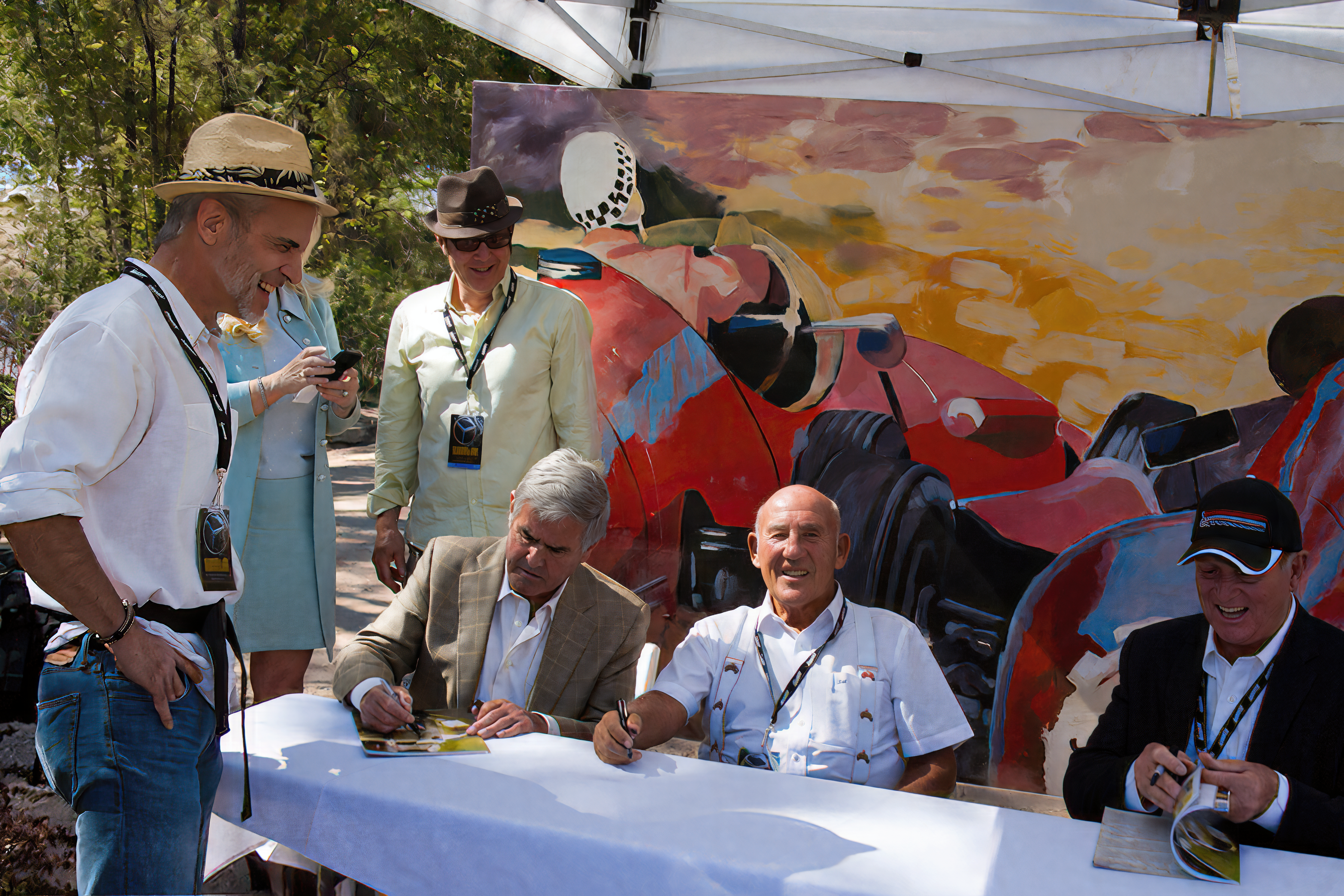
The Gloria Steinem post got me thinking. Every so often, I get to whip out an episode from my past in conversations. I listen to myself, and know that few believe my contentions. I’m more hesitant to do it than ever; my whitening hair and advancing wrinkles just add to the patronization. Every so often, it’s fun to insert some proofs. From left to right … myself (with straw hat), Al Unser, Sir Stirling Moss, and Bob Bondurant. This was the year before I started professionally covering the Santa Fe Concorso car show (2011). I took many photos of these three over the years, but never with myself included. I even worked with Sir Stirling directly to try to republish his “All But My Life” book. Using this photo here to test a feature on my reconstructed blog.